How to Make a Hand-Tied Bouquet: Spiral Technique in 4 Steps
Walk into any good flower shop and you will see the same thing: bouquets that stand up in a vase without a single piece of foam. Nobody is using magic. They are hand-tied, which means the stems were built into a spiral, one at a time, in the florist's hand. Once you know the pattern, you can do it at your kitchen counter with flowers from the grocery store.
This guide covers what a hand-tied bouquet is, the four steps we repeat every day, the tools and flowers that make it easy, the mistakes that ruin the shape and how to keep the result fresh for a week or more.
What a hand-tied bouquet actually is
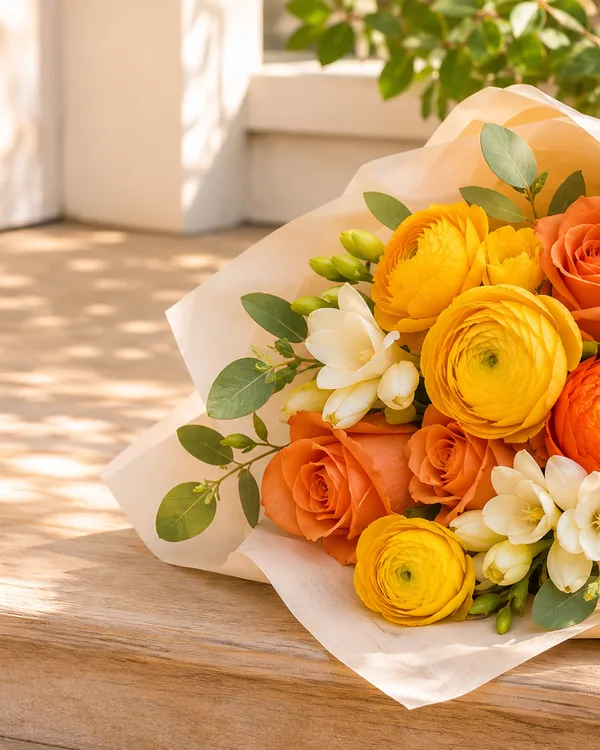
A hand-tied bouquet is a bunch of flowers arranged in the hand, bound at a single point with twine or a rubber band, and cut flat at the bottom so it can sit in a vase or be wrapped in paper. The stems are crossed in a spiral, which pushes them outward below the binding point and holds the flower heads in a round dome above it.
That structure is why it stands up by itself. The crossed stems form a wide base, like a tripod, and the water line stays clear of leaves. Compare that with flowers dropped into a vase one by one: they lean, flop and need constant fixing.
Tools and flowers you need
You need very little. A hand-tied bouquet is a technique, not an equipment list.
- Sharp floral snips or clean garden shears. Kitchen scissors crush stems and block water uptake.
- Natural twine or a strong rubber band. Twine looks better and does not slip.
- A clean bucket or vase. Bacteria on old vases shorten flower life more than anything else.
- Kraft paper or tissue if you plan to give the bouquet as a gift.
For flowers, think in three groups and buy a few of each:
| Role | Examples | How many stems |
|---|---|---|
| Focal flowers | Roses, ranunculus, peonies, lisianthus | 5 to 7 |
| Secondary flowers | Spray roses, stock, snapdragons, alstroemeria | 5 to 8 |
| Greenery and filler | Eucalyptus, ruscus, waxflower, baby's breath | 4 to 6 |
For a first try, a grocery store mix works fine. Look for stems that are firm, with tight buds and no brown edges on the petals. A bunch of 15 to 20 stems makes a bouquet about 10 to 12 inches wide.
Step 1: Clean the stems
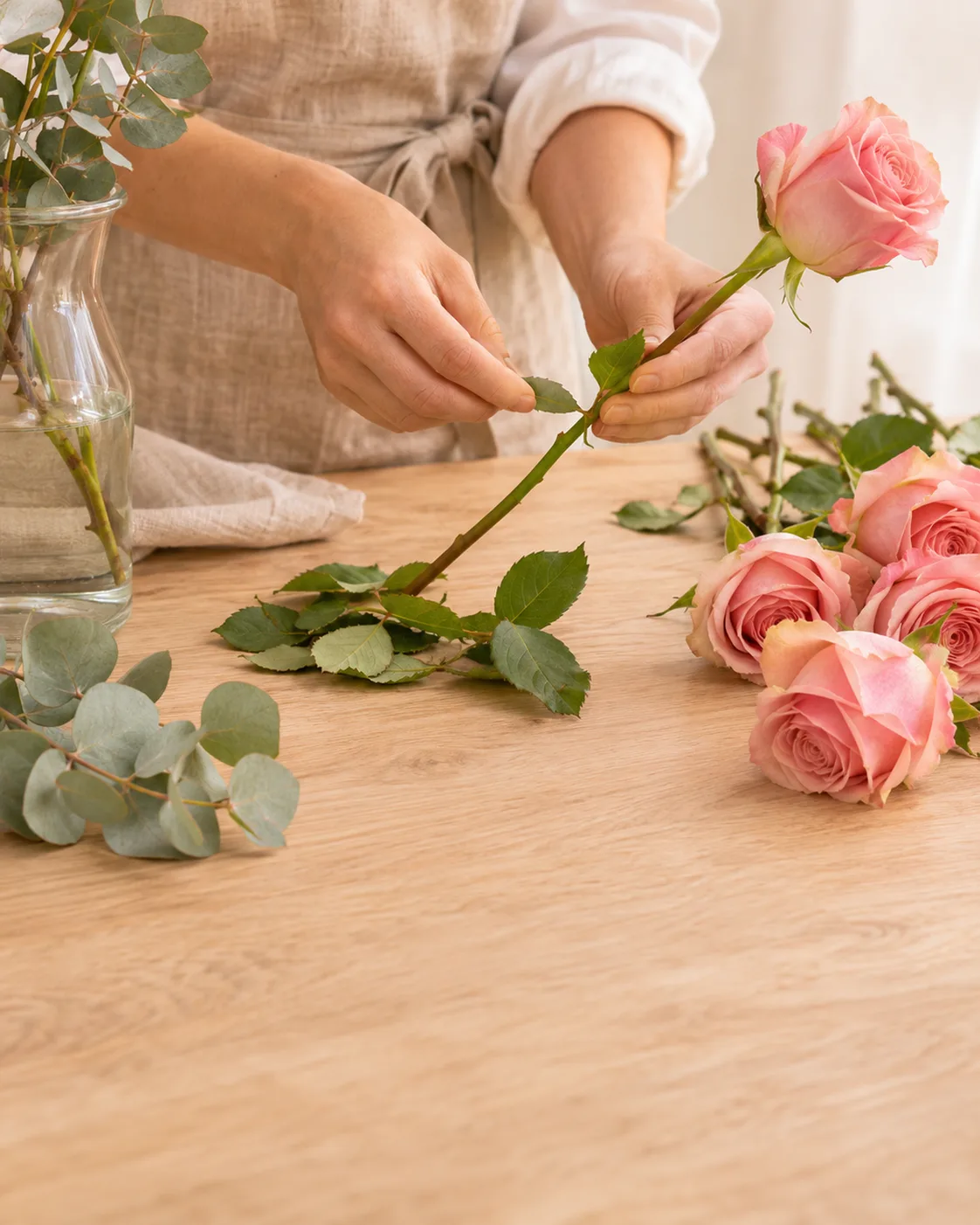
Strip every leaf and thorn that would sit below the water line, which is usually the bottom half of the stem. Leaves in water rot within a day or two and feed bacteria, and that bacteria is what turns vase water cloudy and makes flowers droop.
Run your thumb and finger down the stem from the middle to the base and the leaves come away. For roses, a clean snip or a gentle pinch removes thorns. Keep a few leaves near the top of the stem, because they will become part of the bouquet's greenery.
While you are at it, sort the stems into piles by type. Building is much faster when every flower is within reach.
Step 2: Spiral as you add stems
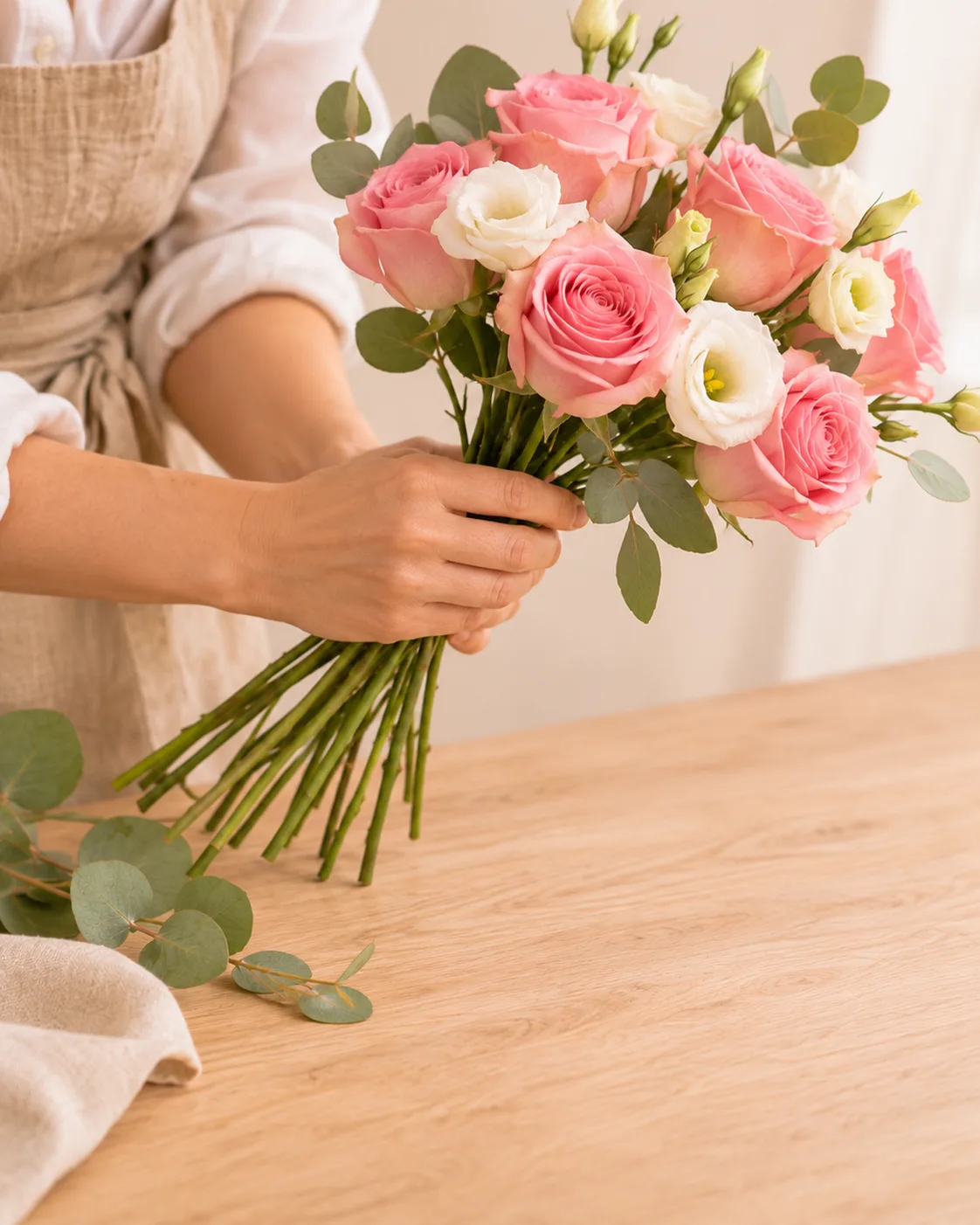
Start with the strongest stem, usually a focal flower or a sturdy piece of greenery. Hold it in your non-dominant hand, about a third of the way down from the flower head. This spot is your binding point, and your hand will stay here for the whole build.
Now add a second stem at an angle, laying it across the first. Turn the bunch a quarter turn in your hand. Add a third stem across the others in the same direction, and turn again. Keep going:
- Every new stem goes in at the same angle, leaning the same way.
- After each stem, rotate the bouquet slightly in the same direction.
- Place flowers so the tallest ones sit near the center and the shorter ones around the edges.
- Add greenery between flowers, not only on the outside.
The rule that matters most is consistency. If one stem leans left and the next leans right, the spiral breaks and the bouquet comes out lopsided. Keep your grip loose enough to slide stems in, and tight enough that nothing drops.
Step 3: Tie, then recut
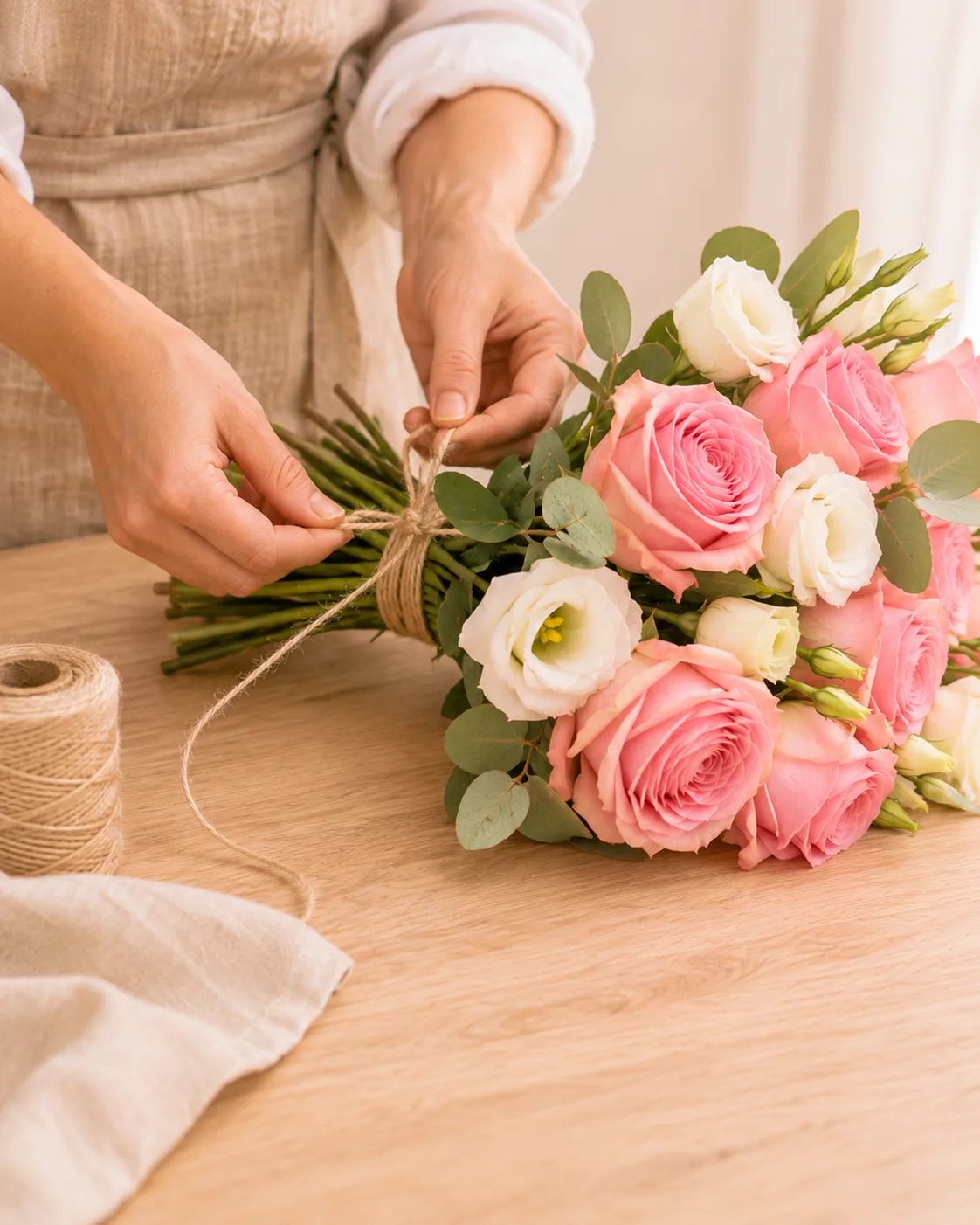
When the bouquet looks round and full, hold it firmly at the binding point. Wrap twine around the crossing three or four times, pull tight and finish with a double knot. If you use a rubber band, double it over so it does not loosen when the stems settle.
Then check the bouquet from every side. Gaps are easy to fix now: slide one more stem into the spiral, following the same angle, and retie.
Next comes the recut. Hold the bouquet by the binding and cut all the stems at once with a sharp pair of snips. Cut at a 45-degree angle. An angled cut exposes more of the stem to water and keeps the stems from sitting flat against the bottom of the vase, which can block uptake. Aim to leave stems about one and a half times the height of your vase.
Step 4: Water right away
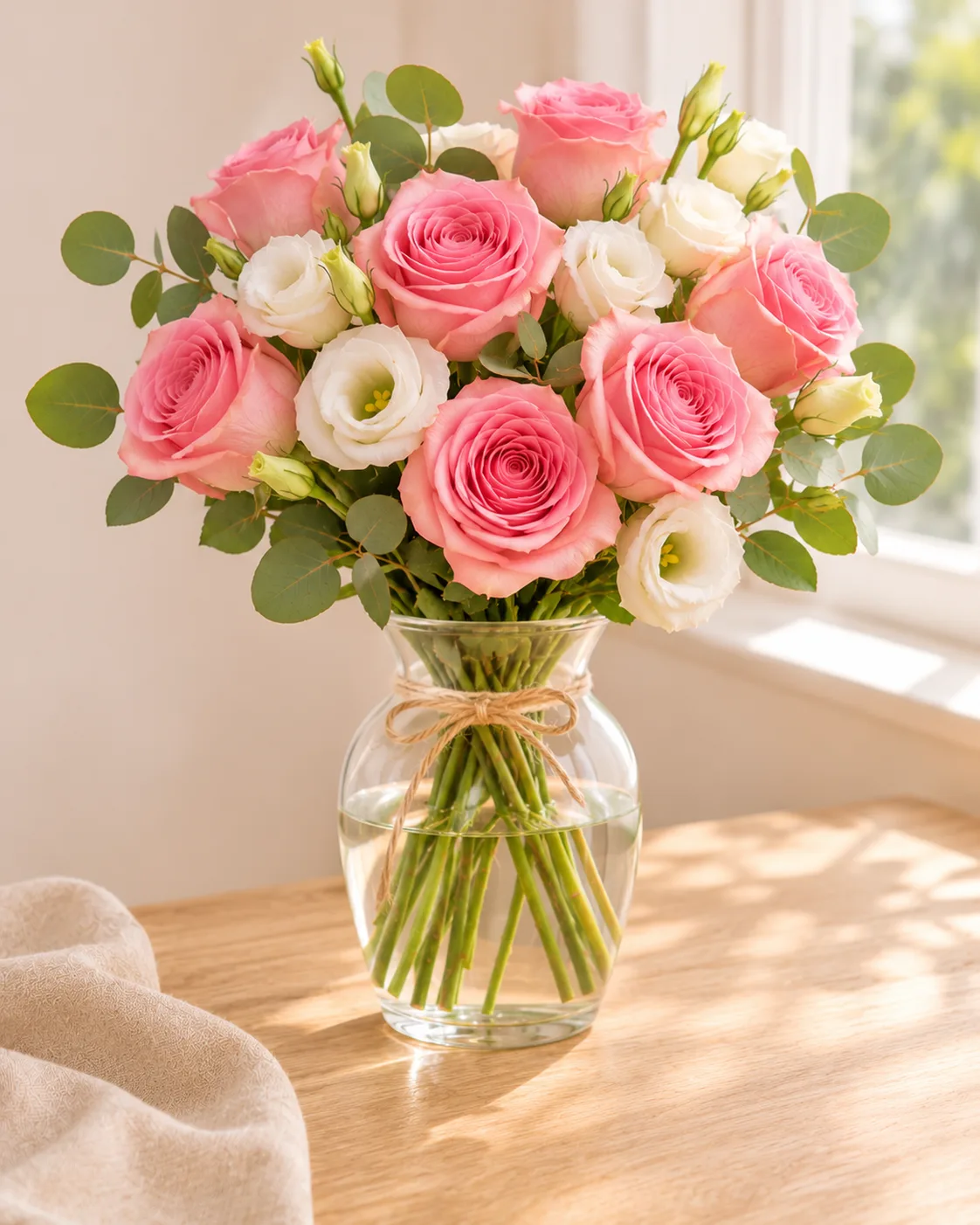
Cut stems begin to seal within minutes, and the sooner they go into water the longer the flowers last. Fill a clean vase with cool water and flower food, drop the bouquet in and let it drink for a few hours before you move it.
Here is a quick reference for how long common flowers last in a hand-tied bouquet when they are fresh from the shop:
| Flower | Vase life | Notes |
|---|---|---|
| Roses | 5 to 7 days | Recut every two days |
| Lisianthus | 7 to 10 days | Open slowly, good value |
| Ranunculus | 5 to 7 days | Soft stems, handle gently |
| Alstroemeria | 10 to 14 days | One of the longest lasting |
| Eucalyptus | 7 to 14 days | Lasts even after drying |
| Tulips | 4 to 6 days | Keep growing in the vase |
For more ways to extend that number, read our 12 florist tips for making flowers last longer.
Common mistakes and how to fix them
- The bouquet is flat on one side. You stopped rotating. Keep turning after every stem, always the same direction.
- It will not stand up. The binding point is too low or the stems are too short. Retie higher and recut longer.
- Heads are crushed. Your grip is too far up. Hold at the binding, not the blooms.
- It looks sparse. Add greenery. A few eucalyptus stems add volume for $3 to $5.
- Stems slide out of the twine. Wrap more times and double-knot, or switch to a rubber band first and cover it with twine.
Most of these come from rushing. Slow down for the first ten stems and the rest builds itself.
Choosing colors and a shape
A bouquet that looks expensive usually follows one simple rule: pick two or three colors and repeat them. Blush pink, cream and a touch of green is the easiest palette and it suits almost any occasion. For something bolder, pair one saturated color such as coral or burgundy with plenty of greenery so the eye has a place to rest.
Shape comes from stem length. For a classic round bouquet, keep the focal flowers at the center slightly taller and let the secondary flowers sit lower around them. For a looser garden look, mix in a few taller stems like snapdragons or stock and let them rise above the dome. Both styles use the same spiral. The only difference is where you place each stem as you build.
Scent matters too. Heavily scented flowers such as lilies and stock can overwhelm a dining table, so keep them for a hallway or a gift and use roses, ranunculus and lisianthus where people eat.
What a hand-tied bouquet costs in 2026
Making one at home is cheap. Buying one from a local florist costs more because you are paying for fresh stems, design time and, in most cases, delivery. Here are typical Orange County ranges for 2026:
| Option | Typical price |
|---|---|
| Grocery store flowers for a home build | $15 to $25 |
| Small florist hand-tied bouquet | from $45 |
| Medium hand-tied bouquet | from $75 |
| Large premium hand-tied bouquet | from $120 |
| Same-day delivery fee | $10 to $25 |
If you want a hand-tied bouquet delivered rather than built, a florist near the recipient can often do same-day. We explain how that works on our same-day flower delivery in Orange County page.
Wrapping a hand-tied bouquet as a gift
If the bouquet is for someone else, wrap it before you put it in water, or give it with a wet wrap around the stems. Lay a sheet of kraft paper on the table at a diagonal, set the bouquet in the middle with the heads near one corner and fold the sides up and over the stems. Tie the paper at the binding point with a ribbon or a length of twine.
A bouquet wrapped this way keeps its shape for an hour or two out of water. For longer trips, pour a little water into a small bag, tie it around the stem ends and wrap the paper over that.
Hand-tied bouquet FAQ
What does hand-tied mean in floristry?
It means the flowers are arranged in a spiral by hand and tied at one point with twine or a band, without foam. The spiral holds the shape and lets the bouquet stand in a vase.
How many flowers do I need for a hand-tied bouquet?
About 15 to 20 stems makes a medium bouquet. That is usually 5 to 7 focal flowers, 5 to 8 secondary flowers and 4 to 6 stems of greenery.
Where should I tie a hand-tied bouquet?
Tie it at the point where the stems cross, about a third of the way down from the flower heads. Tying higher makes the dome tight, tying lower makes it loose.
Why cut the stems at an angle?
An angled cut gives the stem more surface to take in water and stops it from sealing against the bottom of the vase. Recut again every two days for the best results.
Can I use grocery store flowers?
Yes. Choose firm stems with tight buds, remove the packaging right away and recut before you build. A grocery bunch costs $15 to $25 and works well for practice.
How long does a hand-tied bouquet last?
Most last 5 to 10 days with clean water, flower food and a fresh recut every two days. Alstroemeria and lisianthus last the longest, tulips the shortest.
The short version
- Strip all leaves below the water line.
- Add stems at the same angle and rotate after each one.
- Tie with twine where the stems cross, about a third down from the heads.
- Recut at 45 degrees and put the bouquet in water right away.
- Practice with a $15 to $25 grocery bunch before buying premium stems.
Once your hands know the spiral, every bouquet gets faster and better. FlowerEase is opening soon in Irvine and across Orange County, with same-day delivery in 3-hour windows from a florist near the recipient, a photo of every bouquet before it leaves the shop and reminders for the dates you care about. Until then, browse more guides on the FlowerEase blog, including what rose colors mean.